


Mimic The Forest
- Jamon Mysliwiec

- Sep 24, 2022
- 3 min read
Have you ever noticed how the forest grows prolifically, but conventional garden's die if we don't tend to them?
Nobody tills, waters, or fertilizes the forest. But it keeps growing. If we have to fertilize to grow big fruits and vegetables.. how come nature can produce an abundance of food sources with zero input from our fertilizers, composts, or other nutrient cures??

How do plants in nature eat?
What an ingenious design it must be, for the forest to feed every living thing in the planet, with nobody showing up to work.. We can mimic this pattern and design by building gardens the way nature is build. By selecting species of plants that serve a function at every layer. Here is one important element to understand when growing your biologically diverse, self sustaining garden, homestead, and ultimately, food forest. This excerpt was taken from one of my favorite books, "Water For Any Farm":

How nature creates its own fertilizer:
"Sugars are the primary products of photosynthesis, and are constructed from hydrogen, carbon, and oxygen. A plant takes carbon dioxide out of the air. Releases oxygen back to the atmosphere, and quite literally pumps carbon into the soils. The whole host of micro organisms existing in the soil consumes these simple sugars, and their populations increase. While growing these organisms are keylating soil minerals. Dissolving them with acids, grinding them in gizzards, and eventually incorporating them into their own tissues. While they are doing this they are reproducing, excretion wastes, and dying. Their dead bodies and there excreta become additional food for soil organisms, and the plants that fed them. In addition to exuding simple sugars plants stuff off roots. As the plants grow they push their roots into the pores spaces between soil particles, almost hydrologically. They slip tiny root hairs, included in cell walls made of complex carbon compounds, into the pores spaces and fill them with protoplasm(sugars and protein rich fluid). As the cells grow, pore spaces are enlarged. In essence, the soil is hydraulically fractured by the insertion of sugar filled balloons between soil particles and the subsequent pumping them full of fluid. As a regular part of their growth and internal processes of transporting nutrients within themselves, many roots and root hairs will die back. Leaving their energy rich remains behind. Once again soil life flourishes in this medium. Which creates the very fertilizer the plants need to grow."
This biological process sounds complex, and while the study of it can be quite in depth, the reality is it is quite simple to mimic.

In conventional agriculture, the soil is tilled, broken up, and left exposed to the sun. The only plants available are whats planted in rows. There is no mulch. 90% of the water sprayed on bare soil, is evaporated off... that is a HUGE number. But with adding only 1" or more of mulch, the equation reverses, and 90% of water is retained. The forest doesn't just self fertilize, it self mulches.
As I am writing this I am sitting on a rotting old log from a fallen tree in Eastern Tennessee.

I am surrounded by natural mulch, which you can see in some of the photos below. It is compromised of leaves, grasses, decomposing sticks, twigs, and larger logs like the one I am sitting on.
Small amounts of vegetation grow in the pockets of sunlight coming through the upper canopy, and where there is more sunlight, there is more plants there to capture it before it touches the mulch, ultimately keeping it off the forest floor.
Imagine for a moment,
If you duplicated the pattern you find in the untouched spaces of the forest floor nearest to your home, where you see an abundance of growth in nature uninterrupted by people, concrete, and construction.
Below the mulch in these photos, the process highlighted above is taking place. From the trees of the upper canopy, to the bushes, shrubs and the very ground cover and rhizome roots below the surface.
This is how vegetation was designed to grow by the creator of our beautiful planet. And for us to have this same level of abundance in our cultivated productive spaces, we would do well to pay attention.



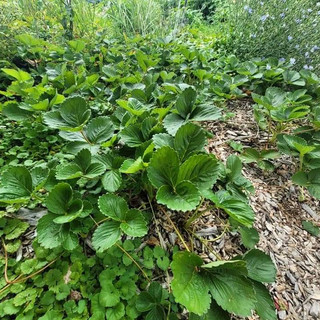


I invite you to visit a local forested thriving area of wild land nearest to your garden, home or city.
Approach the space with an investigative eye, and replicate the forest floor in your garden space to the best of your ability.
Substitute what you don't have for like materials. For example, fallen sticks and twigs can be replaced with woodchips. Grasses and dead plants can be replaced with straw.
I've added photos of our last garden project applying these methods and principles, for your easy reference.

To learn more about the differences between these two and why you find more grasses in the annual fields and more wood in the perennial forests,contact us! And of course, enjoy your experience!


Comments